This is a hillfort from the Iron Age. It is a type of historical fortress carved, as its name suggests, atop an impressive natural hill. Literally thousands of similar monuments are scattered across the British landscape.
But this site in Wittenham, Oxfordshire, is highly unusual, because directly next to it is another, even more impressive hill, and nothing appears on it except a cluster of trees. This second hill, known as Round Hill, has puzzled archaeologists for centuries. They are confident it is related to the tribe that built the Iron Age hillfort.
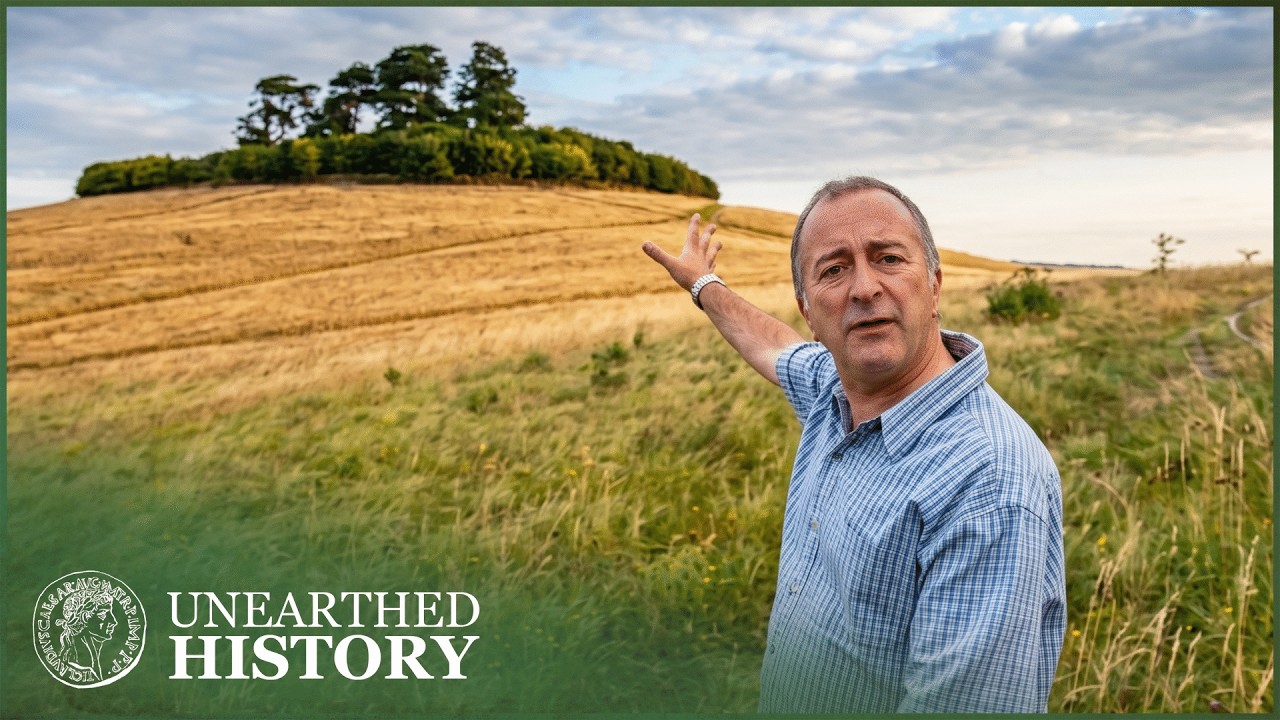 But what is that relationship? Previous archaeological work was limited in scope, but it provided some tantalizing evidence. In the eighteenth century, two skeletal remains were found at the top of the hill.
In the 1940s, archaeologists dug a small trench somewhere below and found evidence of a building and large quantities of Iron Age pottery. So clearly something was happening here. But what?
And how does it relate to the hillfort? We have only three days to find out. Oh, and we have a slight problem with a few things.
A local archaeology unit has been excavating the hillfort for the past three weeks. It has never been excavated before, and they hope to discover when and how it was built, and what it originally looked like. They also want to know what the Iron Age inhabitants used the adjacent hill for.
Round Hill is only 200 meters away and is actually higher than the fort, but they do not have the time or money to investigate it, and that is where we come in. So how can we help you with what you are doing? Well, we have focused on the fort.
It has never been excavated, but it is assumed to date to around 600 BC, while the other hills are more mysterious. I think there is a lot to be done there because we simply do not have enough information. What are we going to do then, Mick?
Well, in the eighteenth century, they found burials on the other hill here. So we have already started digging a trench in the woods there to see if we can solve this mystery. Okay, you have already started work, but we have not even done a geophysical survey.
No, but it is difficult to conduct a geophysical survey in wooded areas like this. So we had to look for places where there are gaps between the trees. Then about 60 years ago, a local man named Rhodes dug a pit here.
He found the remains of what may have been a Roman villa, but he also found enormous quantities of Iron Age material. So perhaps there was some kind of settlement in this area aligned with the hill, so the nature of the relationship between them would be interesting. So we are starting at a very fast pace.
Phil and Frances are excavating the top of our hill. They have no idea what they will find. There may be buildings here or more bodies, but they are convinced there is definitely something.
And we are not limiting ourselves to the hilltop only. It was somewhere on this hill that local archaeologist B. B.
Rhodes discovered his Iron Age building. We want to know whether it was an isolated building or part of a much larger settlement. But first, we have to find his trench.
We have the measurements. He tells us that the center of his square trench was 510 feet from Little Wittenham and Wallingford road at the point where the footpath meets the road here. So 510 along that road and then 103 between the center of the trench and back to the road.
And all of that in feet, of course. Yes. Not in meters.
We can calculate the distance we need to walk along the road using a little math, it is just a basic offset from that point. If they can find Rhodes’s old trench, we will be able to reveal more of the Iron Age building he found. Do you think you can get to that before the geophysics team?
Not a big challenge, is it? The question then will be whether the people who lived in Rhodes’s Iron Age building had any connection to the fort rising above them, where Tim and his team have already opened a wide trench across the ramparts. They are looking for pottery and features to help date the hillfort and find out how and why it was built.
We have not yet approached the bottom of this ditch, but the scale of these ramparts is truly astonishing. I mean, you have made a huge cut through them, haven’t you? To get, most likely, the side section of the ditches all the way from the inside to the bottom.
The goal is actually to get back to the chalk layer and obtain the full sequence if there is more than one pit in the ditch. After all, these sites were sometimes used for hundreds of years. Of course, when they were originally dug, that chalk they took out from the bottom along the side to the top of the rampart and to the outside must have been an incredible sight.
Somewhat gleaming white, and certainly, and from here, of course, on the opposite Berkshire hills, there were other hillforts you could see on a clear day, and they could have seen us here on Castle Hill. Presumably there were palisades along these banks. Well, yes, we are actually, here, we have just begun to reveal the outside.
Look at that. Yes. Yes.
Come and take a look. We have just cleaned this with the machine, but we have already revealed these dark circles. One here, and one here.
Oh, yes. They are exactly exactly what we think may be where the posts stood at the front of the rampart. So, so this would have carried the fighting platform at the top.
Actually, that is right. From the size of the postholes, Tim estimates that the palisade would have provided a strong and impressive additional line of defense above the ramparts. The top of Round Hill proves to be a more complicated proposition.
Try that. Try that. Phil could only dig two small trenches between the trees.
So far, there is no trace of buildings or bodies. What is normal? It is a layer of sand and gravel on top with gorek clay and chalk.
This is what we have here. There is a patch of gravel showing. And this is the clay.
So, nothing at all in the first trench. And the story from the second trench is equally frustrating. It is completely sterile.
Very small. No traces. Nothing here.
No, there is nothing. It is just beautiful geology. There may be valuable remains on top of this hill, but due to the density of the tree cover, we simply cannot access them.
And Mick gives the order to abandon the top. What a disaster. But perhaps not all is lost.
We still have a vast area of land below the summit to explore, and the possibility of discovering an Iron Age settlement there if we are lucky. If the geophysics team can provide us with the target. So what do we have, John?
Well, oh my. That is good. Yes, that is wonderful.
We are standing here then. Yes. And that is 80 meters to that point.
You can see this wonderful ditch enclosure with an entrance at that point there. What date do you think this is then? Oh, based on the shape alone, Iron Age, perhaps Romano-British.
Right. Right. Well, that fits with the excavation that was done somewhere in this area before which produced Iron Age and Romano-British pottery.
Presumably we cannot see the roads digging into that. Well, it is certainly 10 feet. I mean, 10 feet is just that, isn’t it?
We have here a 30-meter square. Yes. Yes.
Well, the survey team is trying to locate that now using a combination of junior calculations and satellite survey. So, we are waiting for them, aren’t we? What do you think about that?
Yes. Well, look, I can provide you with some targets in the meantime. I mean, I would personally like to dig that and dig one of these, if not more.
Okay. Great pits. I think I think we should choose these two.
The end should be here. Okay, that is a bit better. Clear and specific targets, and a wide area.
So, we will start digging our next two trenches. Trench three at the enclosure entrance, which perhaps protected a small settlement. And trench four, where we hope to find another section of the ditch and one of the pits.
At least the trenches will be dug when we deal with our next small problem. The Wittenham Clumps area is home to a rare species of animal, the great crested newt. It is protected by law, and we have only been granted permission to dig here on the condition that we adhere to this pre-agreed area.
Before we start digging, we have to mow the area where we want to place our trenches and conduct a careful search. Any newt we find must be moved to a safe place. Will I recognize it if I see it?
Have you seen any of the pictures? You will definitely recognize it. This is what they are looking for.
The great crested newt. And this is a female great crested newt. So it is a task that requires searching on hands and knees.
Definitely. Yes. In a row.
This was not in the contract. Searching in this known area. If I were a self-respecting newt, I would have fled from here as soon as someone came with a lawnmower.
What if its legs are still there? Well, you can see that we mowed the grass at a high height. Um, to reduce the chance of crushing any newt while we do that.
Come out. Come out wherever you are. It is a time-consuming process, but finding no newts is good news.
And an hour after we decided where to place the two new trenches, work finally began. Almost immediately in trench three, Phil finds our first archaeological discoveries. Look at it, isn’t it?
Um, it certainly is. You have mortar on this side and that side. Mortar on at least three or four sides.
It is not a high-quality floor, is it? I mean, it is.. it is a practical and well-made floor.
Definitely. Yes. Yes.
We will dig here with the pickaxe and shovel. We will look into it a little. All the discoveries so far are Roman, but Phil has a long way to go before he reaches the bottom of the old ditch, so it may turn out to be Iron Age.
And Henry is tracing the old Rhodes trench. So, we should find something Iron Age soon. So, here.
Yes. But basically, my measurements from Rhodes are his description of where his trench was, but they are at its center. Here exactly.
Well, look, Phil’s trench passes over the end of the trench at the entrance. Yes. The point you are referring to is about here.
That is completely far from this confusion I am having with the building because it is supposed to be in the southeast corner of that building, but his measurements only place it here. We have things here, but the main building seems to be somewhat far away there. We will see.
We will find out. So, once the area is cleaned, trench 5 will be dug here to locate Rhodes’s Iron Age building. Phil, you had an old, dilapidated trench at the top of the hill this morning.
Is this better? I will tell you, Tony. Things have changed completely.
We are literally getting discoveries by the bucketful. Is all of this from that trench? Definitely.
Would you like to take a look at that? Oh, yes. Isn’t this an amazing assemblage?
It is an old and diverse mix. We have a lot of Roman material, including building materials and a range of pottery, but in particular, we have a lot of Iron Age pottery, I think mostly from the early Iron Age. But the beauty of it is that they are large and clear pieces.
I mean, look at this. Look, it even matches some of it. So, I mean, these things have not been moved far.
And they seem to have somewhat sharp edges, don’t they? They have not been turned over much. And of course, we also have pieces of mosaic.
Yes. So we are dealing with a Roman building with a floor. Yes.
And again this fits with what Rhodes found in 1948. Now that Phil has found Iron Age and Roman pottery in the enclosure ditch, it seems that people were living here from at least 600 BC to about 400 AD. That is a thousand years of continuous settlement.
Inside the enclosure, there is no trace of anything Roman in trench 5 yet, but Matt has revealed a layer of Iron Age pottery. And better still, it is resting on a gravel-paved surface, exactly as Rhodes described. South in that direction, right?
So, if we direct that, he got that side of it in his trench. Our trench clearly got the other side of it and it curves perhaps like this. It looks straight here, doesn’t it?
Yes, it does. Indeed. I mean, this red gravel runs almost directly north to south along that path and there is nothing nothing across that spot at all.
 So we have only touched the corner but we have touched the corner that he did not disturb rather than the other one. Definitely. Yes.
I mean, this place has not been tampered with here. Did you get any pottery? Yes.
Yes. There were some really nice pieces actually. I will come and show you them.
I have got some massive blocks. Huge pieces. Yes.
I mean look at that. Look there. A decorated piece.
Wow. Look at that with a kind of thumb-impressed decoration around it. From the early Iron Age.
I think this is wonderful because one of the things Rhodes says about why he was convinced this was a square Iron Age building is that the layer above it contains almost exclusively Iron Age pottery. Yes. Matt and Corinza are convinced that this is the square Iron Age building that Rhodes described.
The question now is: was it an isolated building or part of a settlement? And did the people who lived in it have any role in the life of the nearby fort? Perhaps like building it in the first place?
Very clever engineering this. I mean it looks like a very large ditch and a very large rampart. That is because it is indeed very large.
No no, the engineers are very clever. What they did simply is take the slope of the hill and cut a terrace into it and then dig down on that terrace. So this creates what appears to be a huge ditch here.
They put most of the material there at the bottom. So from below it looks like a huge rampart with a huge ditch behind it and another huge rampart. It is just clever engineering, minimum effort, maximum effect.
And what is really interesting if you look at it so you go for display purposes more than seriousness actually. I mean I looked at it, I do not believe it. Well, I have looked at hillforts everywhere and what is interesting is that I have seen in many hillforts where you get really massive structures like this on one side and they wrap around the back.
Yes. And there is actually nothing in terms of defensive capability. And if you walk around this place, what is interesting is when you get to the side facing Round Hill.
Yes. Look at the size of the fortifications and the ditches there. And there is nothing of that size here.
You mentioned it is really impressive here. This faces the hill road. And it occurs to me that the opposition was there.
So they made it look really impressive there toward Round Hill. Okay. It is not as amazingly impressive.
So perhaps they were friendly there, but I also would not want to cross those fortifications. I mean seriously, if there are people at the top with slings and bows and arrows. I see you should ask the men on the ramparts.
Is it defense? Defense. Back in the valley below our hill, Ian was trying to understand the nature of the enclosure.
Although he found traces, he is puzzled. Well, yes, it is supposed to be a pit. I mean, here we are looking at the geophysical survey.
It is this row here, isn’t it? Yes. And that spot there is supposed to be it.
Yes. But we found a lot of flint. So perhaps it is the pit fill.
Right. We should see the enclosure ditch there, shouldn’t we? Well, I think we may see the edge of this ditch appearing now.
Right. Do you see that line of white gravel sloping down? Yes.
That is either the edge or fill sloping into a ditch inside all this large black mass. Oh, so that whole thing might be a ditch, mightn’t it? I do not think we have reached the back edge yet.
Right. Okay. End of day one, and after a complete start at the top of Round Hill, we are now grappling with some interesting traces.
We have a huge enclosure ditch, an Iron Age building inside it, a pit filled with flint, and a lot of Roman and Iron Age discoveries. What does all this mean? That is what we have to find out tomorrow.
A new day, a new set of geophysical results, and a big surprise. This is the building we were looking at last night. This is the thing that Karen thought might be a Roman villa or something like that.
And now look at our resistance results. Oh my. This is the same area.
What is this? Resistance. This is the resistance.
The black color shows high resistance. It looks like a building. It is aligned east-west, and there is a hint of an apse at that end.
Which end do you mean? Is that the eastern end? That is the eastern end.
Wait a moment. So, if it is aligned east-west and has an apse, does that mean we are looking at a church or something like that? Wow.
I mean, this is the kind of thing churches are characterized by, isn’t it? I mean, this looks too good to be true. Honestly, I cannot believe it myself.
Where is that on the ground? Well, we are basically here, but it is a somewhat large building. It is 10 to 15 meters long.
We do not need a large trench to find that out. Oh, no. We have to put something across it to determine exactly what it is.
That is right. And to what depth we have to dig, how well it is preserved, and then what kind of building this is. Phil, let me clarify this.
If it is a Roman church, that is very rare, isn’t it? That is very, very rare. And very, very important actually.
We have to solve this. It is the start of day two, and the archaeologists are behaving strangely. They are usually very calm, but you really feel a state of suppressed excitement this morning.
Everything could collapse by tomorrow, but at the moment I feel like we might find something really important, but we will not know until we dig. So once the area is cleared of cover, trench six will be dug here at the southern wall of the possible Roman church. Meanwhile, in trench three, Phil is still trying to date the ditch surrounding the site, and he has found a tantalizing clue.
I will test your knowledge of Roman artifacts now. Oh my. I have a very strange piece here.
Oh my. Look, it is an iron object and it has a socket there. Yes.
Do you see that? Then it widens at this end. It has these two slots in it.
It looks almost like a three-pronged fork. Yes. Yes.
Except there are not many Roman forks. I do not think so. Well, then that is the case.
Is it from a Roman context? Do we think? Did all this Roman pottery accompany it?
There is a piece of mosaic with it. It must be Roman. I have an idea actually.
I wonder if it is actually a pierced spearhead. It is not very common. It is associated in references with a certain rank in the Roman army, beneficiarius.
And it would be a ceremonial object. Coincidentally, we have an inscription from Dorchester just behind the hill recording the presence of a beneficiarius consularis. Discovering a Roman ceremonial spear placed at the entrance means that the ditch is probably Roman and not Iron Age after all.
So to be absolutely sure, Stuart is examining the other part of the ditch in pit number 4. Well, let us continue down to the bottom. I think I am approaching the bottom.
Did you find anything to date it? I think it is definitely Roman because we are finding large pieces of this tile, unfortunately. No need for unfortunately.
Roman is good too. It seems our chances of finding an Iron Age settlement are very slim. We now know that the enclosure ditch is definitely Roman.
And the geophysical survey results indicate a building that is likely Roman as well. The only Iron Age building we have found so far is the one in trench number 5. What began as an Iron Age story has begun to take a somewhat Roman turn.
But there is no doubt that this hill dates to the Iron Age. And at the bottom of a pit inside the enclosure, Tim’s team has made a disturbing discovery. This is the body of a small child.
How did you know it was a child? From the size of the bones, ah, some of them separated while we were cleaning. This specific bone, which is the humerus, I measured it and the measurements indicate that the infant was about one month old when it died.
Can you tell what position it is lying in? We are a little puzzled about that at the moment. Ah, here is the skull.
That is the front. So, it seems the head was pushed down forward directly. Perhaps the body is curled like this, perhaps in a slightly flexed position.
We cannot be entirely sure at the moment. Why would they put an infant in a pit? Well, if this was a rubbish pit, as people previously thought, then they are throwing an infant out with the rubbish.
And now, I do not think people in the Iron Age were like that. People were never like that. So, I think this was a deliberate placement and perhaps it was, you know, a special, respectful, and very sad burial.
Are you convinced by that, Tim? I am not entirely convinced. I think there are a lot of burials as Frances says in these pits, but regarding infants in particular, you know, you find Roman infants in ditches everywhere.
And I suspect they had a different view of how important these infants were. So, perhaps they simply put them in the ground where there were convenient pits. That combines prose and poetry, doesn’t it?
Definitely. Without seeing anything, Phil is tracing our mysterious building in trench six. Really?
Yes. And he has already reached a layer of demolition rubble. Just layers and layers and layers.
It is too early to know if this is the rare Roman church we hope for. Look at that. I think I might need a tray alone for that.
But the roof tiles and mosaic from the rubble have confirmed it is at least Roman. Try to see what the texture looks like. After a few hours, the first traces of the foundations themselves begin to appear.
Phil’s confidence is growing. This is where they think the wall will be. And here we already have large blocks of mortar that may actually represent where they demolished a wall, and we already have pieces of mortar.
And beyond that is where the geophysics indicates the anomalies fade, and we are just moving into ordinary soil. But if we want to prove that this is a church here, the trench must be at the location of the apse. But you decided not to put it at the apse.
That is right. I mean, at the moment, we have not defined the apse well enough. What we wanted to know is what the condition of this building is.
The best way to do that is to place a trench exactly where you have a clearly defined edge. If you have a clearly defined edge, that is the best way to start investigating the building. And if we can solve that, we can either expand the trench or place another trench to look at the apse.
In other words, I will have to exercise some patience, but there is a lot that can be done. We still have an entire Iron Age settlement to find. And Frances seems about to open a new front.
Okay, there is a link. Frances, are you doing new fertilization? I am, Tony.
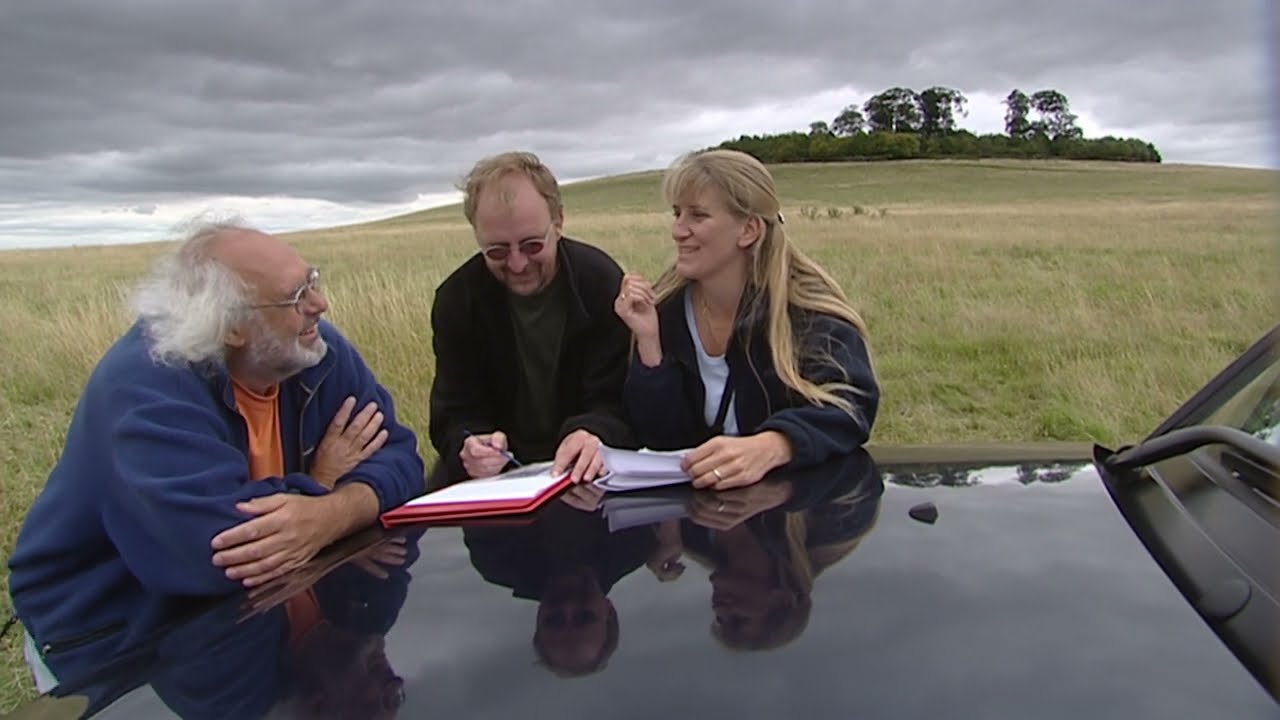 Yes, I am. It is a wonderful change from archaeology. Does this mean you will dig?
Yes. But less than an hour ago, Mick said to me, “Whatever we do, we must not put more trenches. What we need to do is focus on what we already have.”
Yes. Well, I convinced him during lunch. Why?
Well, I am reasonably certain, and I think we all are, that that enclosure is some kind of Roman monument. Yes. And I am interested in those early pottery pieces that were recovered from it.
And near the outside of the enclosure here, there is a group of pits. And I have a very good idea that they will turn out to be from the early Iron Age. So, I am really excited to get my hands on those things.
So, because you are an expert in prehistory, you can impose your authority on Mick who is not simply. Well, I would not say that is what happened, but there was an exchange of views. Why are you excited about the pits?
Well, the thing is that these pits were deliberately filled. The pottery looks very new. It is in excellent condition and we will get environmental samples from them.
They actually tell us how people were living on and around these settlements. So, in fact, the key to explaining the nature of life here lies in those pits. The geophysical survey results show a large spread of pits across the site, indicating a wide Iron Age settlement here.
If Frances is right and these are Iron Age pits, then this is where trench seven comes in at their densest cluster. But in trench six, Phil’s enthusiasm and initial confidence have begun to fade rapidly. The more he digs, the less he finds of our mysterious Roman building.
It seems it was completely destroyed, so much so that not even the foundations remain. I still actually claim that you can see pieces of a robber trench extending over there. I think it has been completely robbed.
I mean, we do not have floors. We barely have walls. So, when they dismantled it, I mean, they dismantled it very extensively.
They took everything away. And the only thing that remained was probably a small pile of debris. So, anything usable like stones or otherwise was almost entirely carried away.
The only thing Phil will struggle to distinguish is the building’s plan, let alone know its function. His only hope is that other parts of it survived better. So, more out of hope than expectation, Phil opens a new trench to see if he can find another wall in better condition, if there is one at all.
Fortunately, the news is better in Frances’s new trench. She has found her pit, and it is full of pieces of Iron Age debris, which will undergo environmental sampling. It looks to me more like sweepings from the floor.
Everything we have found so far has been very small, and that is kind of good. This is what we want. And the things we find here may indicate things like diet and oh, yes.
And ah diet and how they practiced agriculture. I mean, have we found sheep bones or were they growing grain? You know, what was happening here?
So, look, there you go. It is typical, bone fragments are very small. They are all and this has that kind of fracture that happens when you actually break the bone shortly after slaughtering the animal.
So, it is still full of fat and you get this property. It is called spiral fracture. And ah there is a lot of it.
The preservation condition of the bones here is excellent. We have already started sieving the contents of the other pits, and we have found an enormous amount of information that helps us know how life was here in the Iron Age. We have found bones and teeth of sheep, pigs, and cattle.
We have also found traces of wheat and barley. And all of that shows us that this area must have been very rich and fertile for agriculture. But the presence of a fort a few hundred meters away reminds us of a darker side of Iron Age life.
And although the infant in the pit may not have been a military victim, the archaeologists now lifting the bones one by one are disturbed by what they find. I mean, the important thing is that the body of this infant was disposed of differently from most Iron Age dead because we generally do not find them in the ground. And what still bothers me is that the head is really inverted relative to the torso.
That is the top of the head. That is the lower part of the head. And it is completely inverted indeed.
It might have been a sacrifice. Yes. This is a very disturbing idea, but it may have happened.
And once the skeleton was removed, another theory emerged. This is interesting. Do you see that white stone there?
I have encountered that before in an Iron Age context. Yesterday these appeared. They were at a higher level, but in this kind of situation here.
So, it is almost resting on it. It seems as if there was some kind of precise ritual for burying the infant in the ground, doesn’t it? With a kind of yes.
A burnt wooden structure beneath it and then stones placed around its head. A lot of care really. But unfortunately, we will never know if its parents buried it or if it was left as an honored sacrifice to the gods.
In fact, the infant was the least of Corinza’s concerns. She and Matt spent the whole day digging in trench number 5, trying to reveal more of our only Iron Age structure. Yesterday, they found a large quantity of Iron Age pottery dating to the sixth and seventh centuries BC.
And beneath it, a paved floor surface and some postholes. Today they are expanding the trench, going deeper into the remains, and they have found not only more of the Iron Age building, but evidence of a second Roman building. This is the Roman building, the mortar floor, which was mixed with pieces of painted wall plaster from an older building.
So, we know it is an older building. And here below, we have this surface that dates to the Iron Age. But this is the crucial thing.
There are about 8 inches of plowsoil accumulation here without any trace of settlement at all. And this tells us that in the period between the middle Iron Age at the latest and the second century AD, this part of the site was completely abandoned at least. There is no continuity of settlement from the early Iron Age until the Roman period, which means we are not only dealing with Roman and Iron Age stories at this site, but an uncomfortable 300-year gap between them when the site was apparently abandoned.
What is happening this morning? It seems we are all focusing intensely on our mysterious building with the curved plan, and then we seem to be losing that because the walls have been robbed. I just got excited about your digging here, and John has just given me a completely new set of geophysical surveys with a whole set of other targets.
It seems to me we have entered the land of intellectual chaos. Does all this fit together? What we are getting is a focus toward domestic life, so to speak.
You know that what we see here is how people lived at the foot of that hill. So I think we are helping to raise a lot of the questions that Tim is trying to answer in the neighborhood. Now we have the pits.
This is particularly interesting from my point of view because we have now seen these pits and we can identify them in the geophysical survey. We can see how far this Iron Age settlement extends, and it has already exceeded what we expected. We were focusing on one enclosure but we do not know if it is part of a much larger settlement.
So, if we have time, it would be good to take a look at that. I think this is really the crux of the matter, isn’t it? By lunchtime tomorrow, we have to see if we can dig a machine trench across that site.
But we will not move away from a Roman building, will we? Well, Phil says it has been heavily damaged. It has been reused.
We might be lucky if we find just the ruins of this building. Even if we find only the demolished walls, we can still learn something about its size and even its nature. So, I think there is a benefit to be had from it so far.
Therefore, a limited amount of work to solve this would be useful. We might find our applications. Yes.
Yes. Let us do that too. It is..
it is.. So tomorrow, there are more geophysical survey results to explore. A final attempt at the possible Roman church, and hopefully finding an Iron Age settlement to accompany the fort.
Join us after the break. Start of day three here at Wittenham Clumps in Oxfordshire, and two days ago we started excavating the top of that hill and found nothing at all. So we started looking inside this area here because of this wonderful geophysical survey, which is around this place, and we found evidence of two Roman buildings and some Iron Age traces and a large Roman ditch there.
But now, the excavations are spreading everywhere. It now seems as if the settlement was much larger than we imagined. And we want to know more about the people who lived here.
Who were they? How long did they stay here? And what were they doing?
We have only one day left. But we cannot ignore our search for what we hope is a very rare Roman church. Yesterday we were very frustrated when we thought it might have been completely robbed.
But this morning, Phil looks much happier. I have dug down this far and look at what I have reached. This wonderful level, an incredibly solid mortar floor.
I mean, as I scrape it, you can hear how hard it is. It has.. it has been protected by all this demolition rubble.
This definitely means we are inside a building. We must be with a floor of this quality. We thought the entire building would be completely destroyed.
It may not be as badly damaged as we expected. Well, things are going well. What else?
We need to find that third trench across the building we were looking for. These are my applications. Indeed.
They are your applications. Local applications. So, where is the trench designated for that?
Here. Oh, I went back to where I was. Sorry about that.
Yes, this should reach the end of the building. Um, perhaps we will find the apses most likely. Ah, why did you say we would reach the western end of the building?
Do you not think it is an apse? I am not entirely sure, but whatever this thing is. The end of the building.
Definitely the end of the building. The geophysical survey team is expanding their search toward the hillfort to see how far the Iron Age settlement extends in that direction. And finally, Phil has succeeded in opening a trench to look for the apses, so we may get a result on the possible church.
And while he is busy in the trenches, Stuart and I took to the air to get a broader picture, and we were rewarded with the most exciting discoveries yet. They are crop marks, Stuart. Yes.
Look at them. There is a whole complex of them on this side of the road. It is wonderful.
I mean, it looks like there is a series of tracks. There are enclosures. What are those small circles like spots?
Well, I think they must be pits. That must be part of the complex we got geophysical results for on the other side of the road. This is amazing, isn’t it?
We could not have dreamed of better conditions for finding crop marks. With one of the hottest summers ever, followed by sudden heavy rain, the features stand out clearly in the fields. And they become even clearer when the aerial photos are printed.
Crop marks may prove to be one of the most valuable pieces of evidence to help us understand our settlement. What really impressed me about what we saw from the helicopter is that the entire field looked as if it was full of small pits, or small depressions. It is quite clear that in the Iron Age they stored grain in silos, underground silos, cut into the chalk or gravel.
You might think the grain would rot, but we have tried it and it does not rot. What happens is: you seal the top of the pit with clay after putting the grain inside. The grain consumes the oxygen and then becomes inert due to the carbon dioxide in the pit, and it remains like that for several years, and you get the entire stored crop, and all that remains is this surface layer of waste that you have to burn or dispose of.
So that is what you see from all those dark spots, they are storage pits. When you stop using them, they fill them with waste. And of course, that produces a beautiful dark crop mark, and the entire Thames Valley is full of them.
Phil’s new trench has finally revealed the mysterious Roman building, but not quite as we had hoped. He is now convinced that it is far from being a rare Roman church, but is actually a completely ordinary villa. This confusion arose because of the way the structure was demolished.
It seems the western wall was the first to fall, and when that happened all the roof tiles slid to form a neat pile. And that is what looked like an apse in the geophysics survey. But if that was a little disappointing, the overall story of the site is shaping up very well.
We have an enormous amount of pottery spanning from the early Iron Age to the late Roman period. An astonishing duration of 1000 years. But after classifying the finds chronologically, we confirmed what Corinza found in the road trench.
This is from the middle Iron Age, and I had to work hard to find any middle Iron Age material in our assemblages so far. There is much less of it. The late Iron Age, ceramically, is completely absent from this site.
It is simply not there. It must be 400 or 500 years. It may not be that long, but it is certainly up to 300 years.
Paul’s discovery has supported Corinza’s evidence from the road trench showing that the site was abandoned for three centuries, but it still does not explain why that happened. John found something interesting too. The latest geophysical survey results show a few very strange anomalies.
You will like this a lot, won’t you? But there is a price to pay for that. This is the extension of the survey you may notice.
 But what are these then? I do not know. I bet they are burial mounds.
Square Iron Age burial mounds. Are you sure? You do not usually find them in this southern site.
I know. Well, I have excavated some of them in Northamptonshire. I know they are often in Yorkshire, but wow, if they are, what else could they be?
Well, sometimes you get small Iron Age enclosures, square in shape, but they are less than 20 square meters. It is unusual, isn’t it? Yes.
And they have dots in the middle. Oh, yes. We will have to take a look at them, won’t we?
Well, that is the point. If we are going to take a look at them, we have already identified what we can do in our remaining time. If you want to change the agenda, something must be abandoned.
I cannot look at this anymore. Well, this is the obvious thing, isn’t it? That we perhaps leave that and move people to do this here.
But there is another problem. The yes. A bigger problem.
This is the limit of our permit. We can do anything on that side. So, we cannot dig on this side.
In fact, we are outside. It is a very short distance, isn’t it? I mean, I mean, if we are not working there, can we move it to that side?
Hmm, I am not sure it is that easy. I think this is what we will have to try to do. If you insist that you want to do that, we will have to try to negotiate our T-shaped area to go.
We cannot expand the survey area. There is a possibility that we can move it, but the decision is yours. Yes, I think that makes sense because the hillfort is just off the map.
So, we are moving toward the fort and trying to find the link between them. So, on the one hand, I suppose it makes sense to focus our efforts. You can always come back to that later.
I mean, you know, another year, or anything. Another year. Yes.
So, do you want to proceed with that? Oh, okay. I think we should…
I will go and see if I can talk to Tony and we will see what we can do about the area. Okay. Okay.
While we wait to get approval for our new trench, Stuart thinks he has solved the mystery of the missing 300 years. And he has summoned Frances to the hillfort to get his opinion on his new theory. We saw some crop marks in that wheat field there behind the road where the excavations are taking place.
And what I have done is take a look at the photos and transfer them here. What? What is in that wheat field there on the side of the road?
Look at that. This is the road. There is the farm in the distance.
Yes, this is the enclosure that John found in his geophysical survey where the excavations are. So, there is a whole complex of things in the field adjacent to where we are actually working. This is kind of like a category of sites known as banjo enclosures, isn’t it?
It is, isn’t it? Yes. Hmm, which usually date to the middle Iron Age.
And of course that is very exciting because that is what we are missing there. We have the early period and we have the Roman but not the middle. And of course, those middle Iron Age settlements are also associated with the hillfort, as there are many finds from that period here.
Perhaps this was where the people who occupied this site as a hillfort in times of crisis lived. And I do not think we knew that before. I think this is really exciting.
We have got approval to move the T area, but with time running out fast, we urgently need to start. Anything that looks or suggests it is N. If you find one, tell me.
There is no way around the new management plan, these things cannot be rushed. And after a careful fingertip search, that was found. So, with only 4 hours left, it is back to the two veteran experts to see if they can find a square burial mound with an intact Iron Age burial.
Oh. Oh, this is better. It reaches the bottom of Frances’s pit.
And as we hoped, the pottery confirms that the pit dates to the early Iron Age and is contemporary with the hillfort as well. These two veterans make us ashamed of their perseverance. Frances.
Yes, I think I have reached the bottom. They have worked hard for 3 hours and are already almost finished. Yes.
I will tell you something, Phil. If it turns out that this pottery and everything is exactly the same as what is in my pit there, you are talking about a very large settlement, aren’t you? Oh, yes.
Very large yes. You are panting as much as I am, my old friend. Well, I have been digging in a pit.
And on the other side of the site, beneath the flint stones, Ian has revealed another large pit and a huge piece of pottery. This is very impressive. I think it is ready for extraction.
Okay. Great. Great.
There you go. Amazing. Thank you.
Yes, there may be more in this pit. It is very large. Its shape is very flat.
Not very prominent. And I think it is from the early Iron Age. So, we are talking about what, the seventh century?
Yes, why not? Yes, something like that. Oh my.
Yes, I think this is really good. I mean, it is a very wonderful piece of pottery. And it is a very large vessel too.
This huge vessel was made locally and used more than two thousand five hundred years ago by farmers to store their produce. Okay. You have a nice collection of…
most of it from the early period. Yes, that is what yes, this… wait.
What is this? Oh my. It looks like a loom weight, doesn’t it?
Yes, it does. Look, there is a hole passing through it. Right.
Oh my. Yes. Look at that.
Let us take a look. Oh, I love these things. Late Bronze Age, do you think that?
Yes. Technically, it is a pierced cylindrical clay block. I do not want to know what it is technically.
I want to know what it is. Yes, it is from the late Bronze Age. It is a really wonderful piece.
It is more like a clay sausage into which you stick a stick to make the hole, and then you hang it at the bottom of the loom in a row to tension the cloth. Wow. This cylindrical one, we do not find it in the Iron Age, do we?
No, I do not think so. No. So, this dates the place here back a few hundred years.
Yes. Yes. Wow.
I mean, we have enough pottery here too, to suggest that people lived here, because we have structural evidence here. Look, we have a post there and we have another one there too. So, we have started finding actual buildings, I think, inside this enclosure.
Come and look at my trench. I was going to say there is not much in it. But the main thing about this trench is that it is V-shaped.
I cannot see any material from a burial mound that slid in, and the finds were very sparse. Yes, they tend to be sparse. Yes, those came from above.
It looks good. Hmm. Yes.
I mean, it could be a burial mound, but there is no evidence of a mound sliding in. I think we can say it is a possibility, but it has not been ruled out. Yes.
But, let us be honest, we have a lot of evidence that people lived here. We have pits with domestic waste. I think this makes it more likely that we are not dealing with a burial site here.
We simply have a small, nice domestic dwelling. Yes, I think it is a case where we might find both together. After all, the pits are older.
They are from the late Bronze Age or early Iron Age, and this site is from the middle Iron Age or later. So, they could have changed its use to do something else. Yes, I agree with that.
Yes. Okay. No, we are both right.
Do you want that as a JPEG? Back in the operations room, Neil is combining the huge geophysical survey with Stuart’s crop marks and putting them together to create one comprehensive plan. This is that area.
Okay, here we are, Tony. We promised you the full picture with all the evidence, and here it is. It is very beautiful, isn’t it?
It is more than just beautiful. I think it is amazing. I will explain to you what we have here, Tony.
If you remember all the crop marks we saw from the helicopter, this is their detail here. What we have done is transfer them to this shot. And you can see these lines here.
It seems we have two curved enclosures here with tracks and roads and so on. And what I have done is shade in red where I think you have two actual settlements here. This purple line that I have marked is a very straight road.
It is very clearly different from this group. It heads directly toward that Roman enclosure there. Frances Stuart called these settlements.
They look like aliens. They are very strange settlements. They are known as banjo.
And you have these tracks outside perhaps for moving cattle in and out of the settlement. And then you actually had houses in the middle there. It is very unusual in this part of England to find two together.
This is very unusual. Tim, when you were excavating the complex, did you imagine the place here would be full of activity as it is now? Not at all.
No, it has really changed the picture because with everything collected here, I mean, we have the early Iron Age, the late Bronze Age, the middle Iron Age here in these new enclosures, the missing part of this side of the road. And the Romans are wonderful. You have placed the hillfort in its natural context over 1500 years and it did not cost me a single penny.
Do you not believe that? The story of the area around the complexes extends back to the Bronze Age nearly 3000 years ago. We now know that the hillfort was first built around 600 BC.
In its shadow was a thriving community of early Iron Age farmers that extended from the earliest structures directly below the ramparts to Corinza’s farm and far beyond. Then after 300 years they moved to a new banjo settlement and used the hill for agriculture. Eventually the hillfort was abandoned and a Roman villa was built here on the southern slopes of Round Hill.
Three days ago, we came here to try to find out the relationship between this landscape and that hillfort. Like most of us, I thought the answer would come from the most obvious monument here, the top of Round Hill. But if I have learned one thing over the past three days, it is to look beyond the usual.
In fact, the answer came from the aerial photographs, those amazing crop marks, thousands of pottery pieces and building materials, and last but not least, the most comprehensive geophysical survey ever conducted by the Time Team. All of this helped us tell the story of the largest archaeological landscape we have ever discovered. Oh, and we did not find a single piece of the N heat.
Heat.