The monitors screamed a flat, continuous tone that cut through the chaos of the emergency room, signaling a life slipping away. Dr. Richard Pembroke stood with his arms crossed, a smirk playing on his lips as he looked at the young woman desperately performing chest compressions.
“Call it, newbie,” he sneered, his voice dripping with condescension. “You’re just breaking a dead man’s ribs.”
 The entire trauma bay fell silent, waiting for her to break. But Clara didn’t stop. She pushed harder, ignoring the mocking laughter of the seasoned staff.
They saw a frantic, inexperienced girl trying to play hero with a homeless John Doe. They didn’t know who was bleeding out on that table, and they certainly didn’t know the hell Clara had walked through to get here.
Coronado General Hospital was a beast that never slept. Nestled just a few miles away from the sprawling naval bases of San Diego, its level one trauma center saw everything from catastrophic highway collisions to the quiet, desperate tragedies of the midnight shift. For Clara Thompson, walking through the sliding glass doors on her first day felt less like a new beginning and more like stepping back into a war zone.
Clara was twenty-eight, with sharp green eyes and hair usually pulled back into a severe, no-nonsense bun. To the casual observer, her resume painted the picture of a late-blooming nursing graduate. She had her license, her freshly pressed scrubs, and a quiet demeanor that screamed rookie.
What her civilian personnel file conveniently glossed over, obscured by layers of redacted military service records and classified deployment histories, was that Clara had spent five years as a forward-deployed combat medic in the deadliest corners of the Middle East.
She had performed field amputations under mortar fire and stabilized shattered limbs in the back of violently shaking Blackhawks. But when she left the military to take care of her ailing mother, she found that civilian medical boards cared little for field experience. Stripped of her rank and forced to jump through bureaucratic hoops, Clara was reduced to the bottom rung of the hospital hierarchy: the newbie nurse.
Her primary tormentor made himself known within her first hour on the floor. Dr. Richard Pembroke was the hospital’s golden boy.
At thirty-four, he was a brilliant, incredibly arrogant trauma surgeon who treated the ER like his personal kingdom. Tall, impeccably groomed even at three in the morning, and possessing a voice that demanded absolute obedience, Pembroke had a reputation for breaking new nurses for sport.
“Listen up, people,” Pembroke announced on Clara’s third day, clapping his hands as he walked past the nurses’ station. “We have a multi-car pileup on the I-5 coming in. I need my A-team ready.”
He paused, his eyes landing on Clara, who was quietly stocking trauma bays with IV fluids. “Thompson, you stay out of the way. Go restock the supply closets on the pediatric wing.
We need competent hands down here, not someone who’s going to faint at the sight of arterial spray.”
A few of the senior nurses exchanged knowing glances. Brenda, a veteran charge nurse who had survived three hospital administrations, sighed but didn’t intervene. In Coronado General, you either sank or swam, and nobody threw you a life preserver if Pembroke decided you were dead weight.
Clara simply nodded, her face an unreadable mask. “Understood, Dr. Pembroke.”
She didn’t argue. She had learned long ago that arguing with an ego that massive was a waste of breath. But she didn’t leave the ER, either.
She positioned herself near the secondary trauma bays, close enough to intervene if things went south, but far enough away to avoid Pembroke’s immediate line of sight.
The doors burst open. The chaos was instantaneous. Paramedics shouted vitals, the harsh fluorescent lights glaring down on blood-soaked stretchers.
The metallic smell of blood and the sharp scent of ozone filled the air. Pembroke was in his element, barking orders, his hands moving with undeniable precision. Clara watched him work from the periphery.
He was good, textbook perfect even, but he was rigid. He lacked the improvisational brilliance that only came from dealing with the unpredictable chaos of a battlefield.
Over the next three weeks, the dynamic solidified. Pembroke actively sought out opportunities to humiliate Clara. When she suggested a different gauge needle for a dehydrated elderly patient with fragile veins, Pembroke loudly dressed her down in front of a dozen colleagues, accusing her of questioning his authority.
When a frantic mother brought in a seizing toddler, Clara instinctively moved to secure the child’s airway using a modified jaw thrust technique she’d perfected in the field. Pembroke physically shoved her aside.
“Don’t touch my patients, newbie,” he had roared, though the child was visibly breathing better. “You do the paperwork, I do the saving.” The staff began to follow Pembroke’s lead.
The younger doctors snickered when she walked by, and the other nurses pawned off their worst assignments on her: cleaning bedpans, dealing with belligerent drunks, and organizing the morgue logs. They called her the ghost because she was so quiet, so seemingly timid, taking the 𝓪𝓫𝓾𝓼𝓮 without a single word of protest.
But Clara was watching. She was cataloging every doctor’s weakness, every nurse’s blind spot. She knew the emergency room’s rhythm better than the people who had worked there for a decade.
She was a coiled spring holding on to her composure for the sake of her paycheck and her mother’s medical bills. She told herself she could endure anything. She had survived hell.
She could survive Dr. Richard Pembroke until the night the storm hit.
It was a Tuesday in late November, the kind of night where the sky opened up and poured a cold, relentless rain over Southern California. The roads were slick, visibility was zero, and the ER was already at maximum capacity. The waiting room was a sea of coughing children, flu patients, and minor lacerations.
The tension in the air was thick, heavy with the metallic tang of adrenaline and the sharp scent of antiseptic.
At 2:14 a. m. , the double doors of the ambulance bay blew open.
A gurney crashed through, guided by two paramedics who were soaked to the bone and panting heavily. “We’ve got a John Doe,” one of the paramedics shouted over the din of the ER. “Found him pulled from a ditch off Route 75.
Looks like a hit-and-run, maybe a motorcycle spinout. No ID, no helmet found.”
Dr. Pembroke, who was currently charming a wealthy hospital donor whose son had come in with a mild concussion, reluctantly stepped out of curtain three. He walked over to the gurney, his face twisting in disgust.
The man on the gurney was a mess. He was massive, easily over six foot three and built like a tank, but he was covered head to toe in freezing mud, gravel, and blood. His clothes were torn rags, heavy boots caked in swamp muck.
A thick, unkempt beard obscured his face, matted with dried blood. Worse, a cheap, half-empty bottle of whiskey had apparently shattered in his jacket pocket during the crash. The overwhelming stench of cheap booze radiated off him.
Pembroke took one look at the unconscious giant, sneered, and turned to Brenda. “It’s a vagrant. Drunk out of his mind, wandered onto the highway, and got clipped.
Vitals?” “Blood pressure is ninety over sixty. Heart rate is one-ten,” the paramedic recited, wiping rain from his eyes.
“He’s unresponsive. Breathing is shallow.” “He’s intoxicated and in mild shock from the cold,” Pembroke concluded dismissively.
He didn’t even bother to put on his stethoscope to listen to the man’s chest. “Put him in bay six at the end of the hall, hang a bag of saline, warm him up, and let him sleep off the booze. I’m not wasting a primary trauma bay on a drunk transient when we have a full waiting room.
Page me if he wakes up and starts getting combative.”
“Doctor, the impact was significant,” the paramedic started to protest. “I gave you an order,” Pembroke snapped, his eyes flashing dangerously. “Park him in bay six now.”
The paramedics exchanged a frustrated look but did as they were told, wheeling the heavy gurney down the long, dimly lit corridor to the overflow bay, a place usually reserved for sobering up drunks or holding non-critical patients waiting for a bed upstairs.
Clara had been standing near the nurses’ station holding a stack of charts. She watched the gurney roll by. Her eyes didn’t see a drunk vagrant.
Her eyes, trained by years of scanning for concealed explosive devices and subtle signs of traumatic brain injuries in the dark, caught details that Pembroke’s arrogant dismissal had completely missed. She saw the way the man’s massive chest was rising. It was uneven, a paradoxical movement.
She saw the pale, ashen gray color of his skin beneath the mud, a sign of profound, rapid blood loss, not just a chill.
And as the gurney passed, one of the man’s arms hung limply over the side, the sleeve of his jacket completely torn away. Underneath the grime and dirt, Clara caught a glimpse of faded ink. It wasn’t a standard biker tattoo or a prison stick and poke.
It was a highly specific, intricate piece: a frog skeleton holding a trident. It was mostly obscured by a massive, angry, purple bruise that was rapidly swelling across his forearm, but Clara recognized it instantly. She had seen that exact tattoo on the arms of men she had patched up in dusty, blood-soaked tents in Fallujah.
That man wasn’t a vagrant.
Clara put her charts down. The moment the paramedics left bay six, she slipped inside, pulling the curtain shut behind her. The smell of cheap whiskey was strong, but Clara completely ignored it.
She grabbed a pair of trauma shears from her pocket and immediately began cutting away the man’s soaked, heavy jacket and shirt. The moment his chest was 𝓮𝔁𝓹𝓸𝓼𝓮𝓭, her worst fears were confirmed. The entire left side of his rib cage was a horrific, dark canvas of bruising.
As he took a weak, agonizingly shallow breath, the left side of his chest sucked inward, while the right side expanded. Flail chest, Clara’s mind diagnosed instantly. Multiple broken ribs detached from the chest wall.
She grabbed her stethoscope and pressed it to his chest. On the right side, she heard a faint, struggling heartbeat. On the left side, nothing.
No breath sounds. Just a hollow, dull silence. Tension pneumothorax.
His broken ribs had punctured his lung. Air was filling the chest cavity, creating immense pressure that was rapidly crushing his remaining good lung and pushing his heart out of alignment. If that pressure wasn’t relieved, he would go into cardiac arrest in a matter of minutes.
She looked at the monitor. His blood pressure was tanking: seventy over forty. His heart rate had skyrocketed to one-forty.
He wasn’t sleeping off a bender. He was bleeding out internally and suffocating on his own trapped air. Clara burst out of the curtain and sprinted down the hallway.
She found Dr. Pembroke standing at the central desk, sipping a coffee and laughing at a joke one of the junior residents had just told.
“Dr. Pembroke,” Clara said, her voice sharp and urgent, devoid of its usual quiet deference. “The John Doe in bay six is crashing.
He has a severe flail chest and a tension pneumothorax. He needs a chest tube placed immediately, and we need to push O negative blood. He’s bleeding out.”
Pembroke slowly turned around, his smile vanishing, replaced by a look of sheer, venomous annoyance. He looked Clara up and down. “Excuse me,” Pembroke said, his voice dropping to a dangerous whisper.
“Did I ask for a consult from the ward maid?”
“Doctor, he is suffocating,” Clara insisted, taking a step forward. “His trachea is deviating. His blood pressure is dropping by the second.
If you don’t decompress his chest right now, he will code.” “He is a drunk who fell off a curb,” Pembroke practically spat, stepping into Clara’s personal space. The entire nurses’ station went dead silent.
Everyone was watching. “I evaluated him. He is stable.
You do not interrupt me, and you never question my diagnostic assessment. Go clean up room three, now.”
 Clara stared at him. She saw the absolute certainty in his eyes. The certainty of a man who had never lost a brother in arms, who had never watched someone drown in their own blood while begging for their mother.
Pembroke cared more about his ego than the life fading away in the back room. “He has minutes, Pembroke,” Clara said, dropping the title. A collective gasp echoed from the nurses nearby.
Pembroke’s face turned an ugly shade of red. “You are incredibly out of line, Thompson. One more word and I will have your badge stripped and have security throw you out into the rain.
Get out of my sight.”
Clara didn’t blink. The frightened, quiet, rookie nurse vanished, replaced by Sergeant First Class Clara Thompson, 68W combat medic. “Fine,” Clara said, her voice eerily calm.
“I’ll do it myself.” Clara turned on her heel and sprinted to the trauma supply cart. She didn’t bother looking back at Pembroke, who was now shouting her name.
She grabbed a fourteen-gauge angiocatheter, a needle thick and long enough to pierce through muscle and rib down into the pleural space. She snatched a bottle of Betadine, a massive bag of saline, and rushed back down the hallway to bay six.
Behind her, she could hear the heavy, furious footsteps of Dr. Pembroke and the panicked clicking of Brenda’s clogs trying to keep up. “Thompson, stop right there.
You are fired. Do you hear me? You are completely finished in this profession,” Pembroke bellowed, his voice echoing off the sterile walls.
Clara ignored him. She threw open the curtain to bay six. The monitor was blaring its high-pitched warning: heart rate one-sixty, blood pressure fifty over thirty.
The man’s lips were turning a sickly shade of blue. His chest was barely moving. He was seconds away from cardiovascular collapse.
Clara uncapped the Betadine and splashed it directly onto the man’s upper chest, completely ignoring sterile protocols in favor of raw speed. She found the second intercostal space, the gap between the ribs right below his collarbone. She gripped the heavy needle.
“Get away from him!” Pembroke roared, bursting into the bay. He lunged forward to grab Clara’s arm.
“Back off!” Clara shouted with a ferocity that stopped the surgeon dead in his tracks. It was a command barked with military authority, a tone that demanded absolute compliance.
Pembroke, shocked by the sudden aggression from the timid nurse, hesitated for a fraction of a second. That was all Clara needed. She drove the fourteen-gauge needle deep into the man’s chest wall.
There was a loud, distinct hiss, like a tire rapidly deflating, as the trapped air rushed out through the hollow needle. Almost instantly, the man’s chest visibly relaxed. A sudden rush of dark blood followed, splattering onto Clara’s scrubs, but she didn’t flinch.
She watched the monitor.
Within ten seconds, the frantic beeping slowed. The blood pressure began to climb back from the abyss: eighty over fifty, ninety over sixty. The man took a deep, sudden, gasping breath on his own, his chest rising symmetrically for the first time since he had been brought in.
Clara exhaled a breath she didn’t know she had been holding. She secured the needle with tape, keeping the airway open.
“What the hell did you just do?” Pembroke whispered, his face pale with a mixture of shock and sheer rage. “You just performed a surgical intervention without a license.
You pierced his pleural cavity. I’m calling the police. I’m having you arrested for assault.”
Brenda stood in the doorway, staring at the monitor, her mouth slightly open. “Doctor, his vitals are stabilizing.” She was right.
It was a tension pneumo.
“I don’t care if she cured cancer,” Pembroke screamed, finally losing whatever shred of professional composure he had left. “She is a rogue nurse. Security!
Get security down here immediately.” Clara didn’t look at him. She was already moving to the next problem.
“He needs a massive transfusion protocol initiated. He’s bleeding internally, likely a ruptured spleen or liver from the impact. I need two large bore IVs, O negative blood, and we need to get him up to the OR right now.”
“You don’t give orders here,” Pembroke shouted, stepping forward and physically grabbing Clara’s shoulder, trying to yank her away from the bed. “You are done.” “Let go of me, Doctor,” Clara said, her voice dropping to a low, lethal register.
She turned her head, fixing Pembroke with a stare so icy it made him instinctively loosen his grip. Before Pembroke could escalate further, a chaotic commotion erupted at the far end of the emergency room.
The sound of heavy, synchronized boots hitting the linoleum floor drowned out the ambient noise of the ER. Pembroke and Clara both turned their heads. Marching straight through the main triage area, completely ignoring the protests of the front desk staff, were four men.
They weren’t police officers, and they certainly weren’t hospital security. They wore full tactical gear over navy working uniforms. Two of them carried assault rifles slung across their chests, their faces grim and unreadable.
They moved with a terrifying, purposeful intensity that parted the sea of waiting patients and medical staff like the Red Sea.
Leading them was a man in a crisp navy service uniform, the silver eagle of a captain gleaming on his collar. His face was chiseled from stone and his eyes scanned the room like a hawk looking for prey. “Where is he?”
the captain demanded, his voice carrying effortlessly across the large room. It wasn’t a question. It was an order.
The front desk clerk was stammering, pointing a trembling finger towards the back hallway. The squad of heavily armed men marched straight down the corridor, heading directly for bay six.
Pembroke, sensing the sudden shift in power, puffed out his chest and stepped out of the bay to intercept them, eager to reassert his dominance over his territory. “Excuse me, gentlemen,” Pembroke said, holding up a hand, using his best authoritative doctor voice. “This is a restricted medical area.
You cannot bring weapons in here. I am Dr. Richard Pembroke, the attending trauma surgeon, and I must ask you to leave immediately.”
The captain didn’t even slow down. He completely ignored Pembroke, brushing past him as if the doctor were nothing more than a minor annoyance, a piece of furniture in the hallway. One of the tactical operators subtly stepped into Pembroke’s path, pressing a heavy gloved hand firmly against the doctor’s chest, pinning him against the wall with casual, terrifying strength.
“Hey! You can’t do that!” Pembroke sputtered, struggling uselessly against the operator’s grip.
The captain stepped into bay six, his eyes immediately locking onto the massive unconscious man on the gurney, taking in the blood, the mud, the makeshift chest decompression needle jutting from his collarbone. For a long, agonizing second, the room was completely silent, save for the rhythmic beeping of the heart monitor. “Report,” the captain said, his voice quiet but echoing with an authority that made Pembroke’s previous shouting seem like a child’s temper tantrum.
Clara stood at attention, a reflex drilled into her bones. She didn’t hesitate. She didn’t look at Pembroke.
She looked directly into the captain’s eyes. “Sir, patient presented approximately twenty minutes ago as a John Doe. Severe blunt force trauma to the left thorax.
Dr. Pembroke diagnosed alcohol intoxication and ordered no intervention. I observed paradoxical breathing and signs of severe hypovolemic shock.
I diagnosed a tension pneumothorax and initiated a needle decompression to prevent imminent cardiac arrest. He requires immediate surgical intervention for suspected internal hemorrhaging.”
The captain looked at Clara, then down at the needle perfectly placed in the man’s chest, saving his life. Then he slowly turned his head to look over his shoulder at Dr. Pembroke, who was still pinned against the wall, looking pale and thoroughly confused.
“You diagnosed him as a drunk,” the captain said, his voice laced with venom. “He had no ID and he smelled like whiskey,” Pembroke stammered, his arrogance rapidly evaporating under the devastating glare of the Navy officer. “He was unkempt.
Look at him. He looks like a homeless vagrant.”
The captain’s jaw tightened. He stepped closer to the bed and gently, respectfully, lifted the unconscious man’s right arm, the one Clara had noticed earlier. He wiped away a thick layer of mud and dried blood with his own thumb, fully revealing the intricate tattoo of the frog skeleton holding the trident.
“This homeless vagrant,” the captain said, his voice dropping to a dangerous, deadly whisper that chilled the entire room, “is Commander David Reynolds. He is the commanding officer of SEAL Team Six, and he was returning from a highly classified debriefing when his transport was run off the road by an eighteen-wheeler.”
The color completely drained from Dr. Pembroke’s face. He opened his mouth, but no sound came out.
The captain turned his back on the doctor and looked at Clara. He took in her blood-stained scrubs, her steady hands, and the unmistakable posture of a soldier who had seen the worst of humanity and held the line anyway. “You saved my commander’s life tonight, nurse.”
The captain trailed off, looking at her name badge. “Thompson, sir.” “Clara Thompson,” she replied, her voice unwavering.
The captain’s eyes narrowed slightly as he studied her face. “Thompson, 68W, 101st Airborne. Fallujah, 2018?”
Clara’s breath hitched slightly, but she maintained her bearing. “Yes, sir.” The captain nodded slowly, a look of profound respect washing over his hardened features.
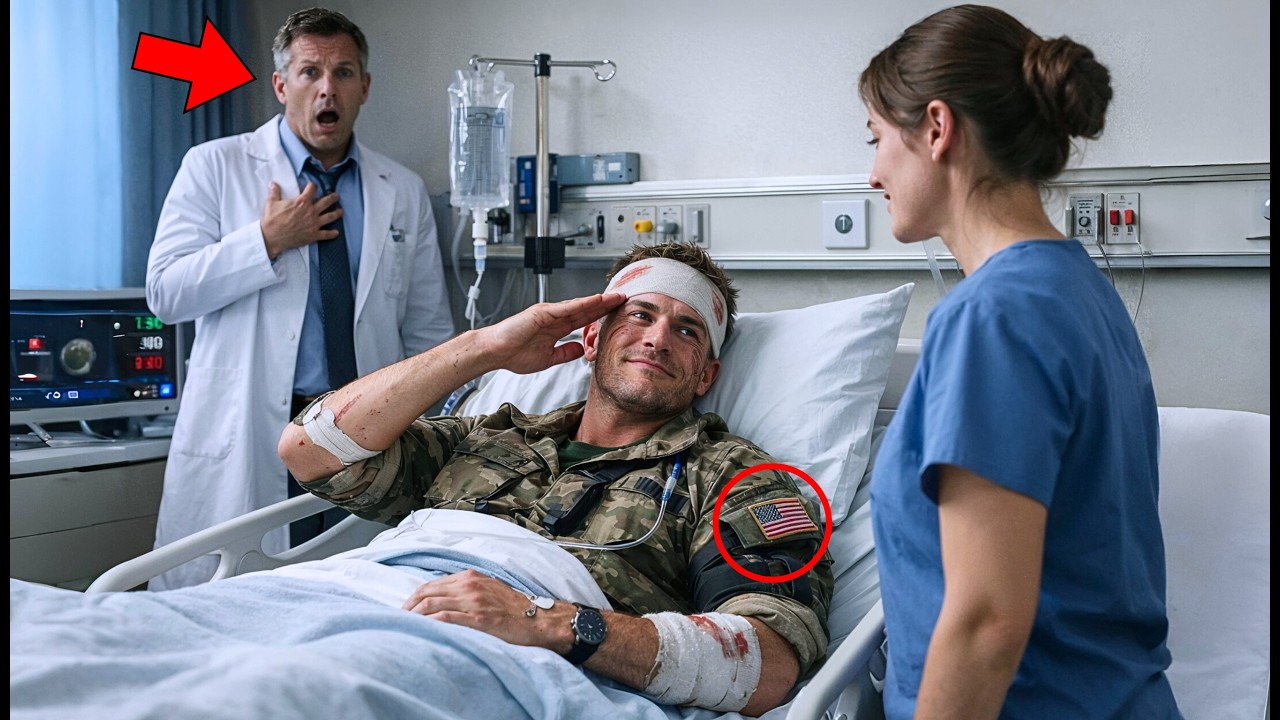
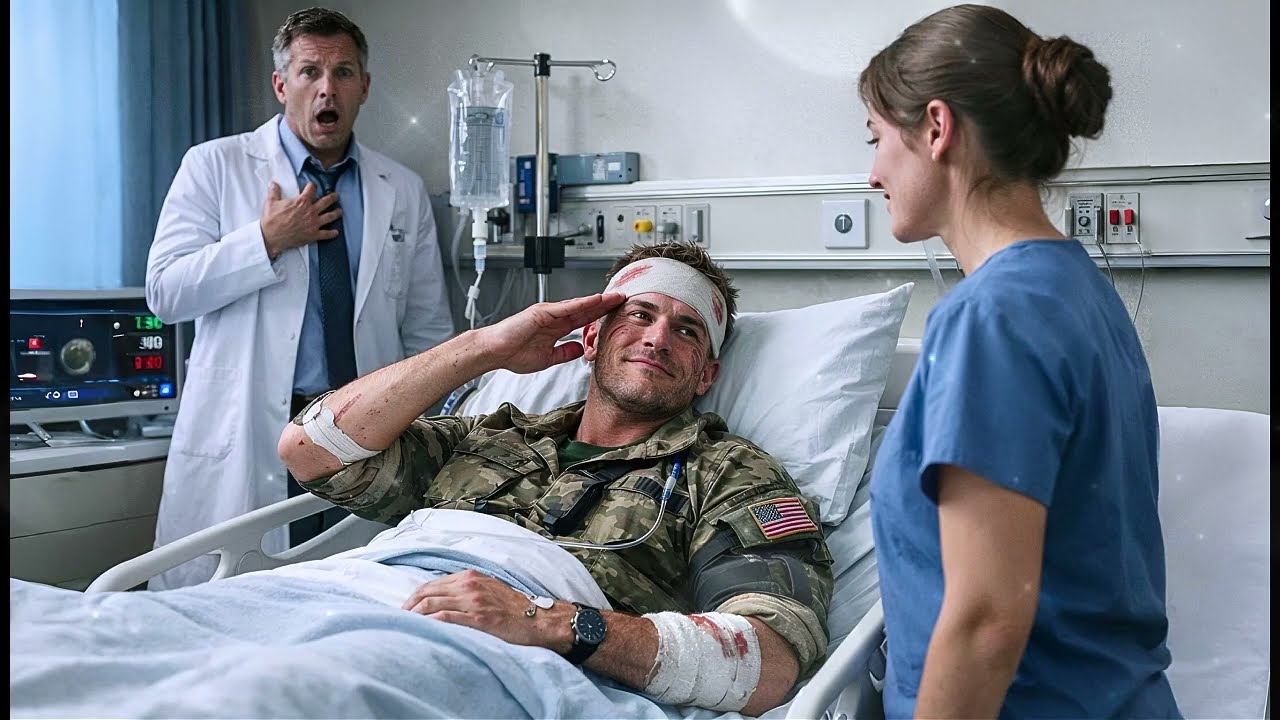
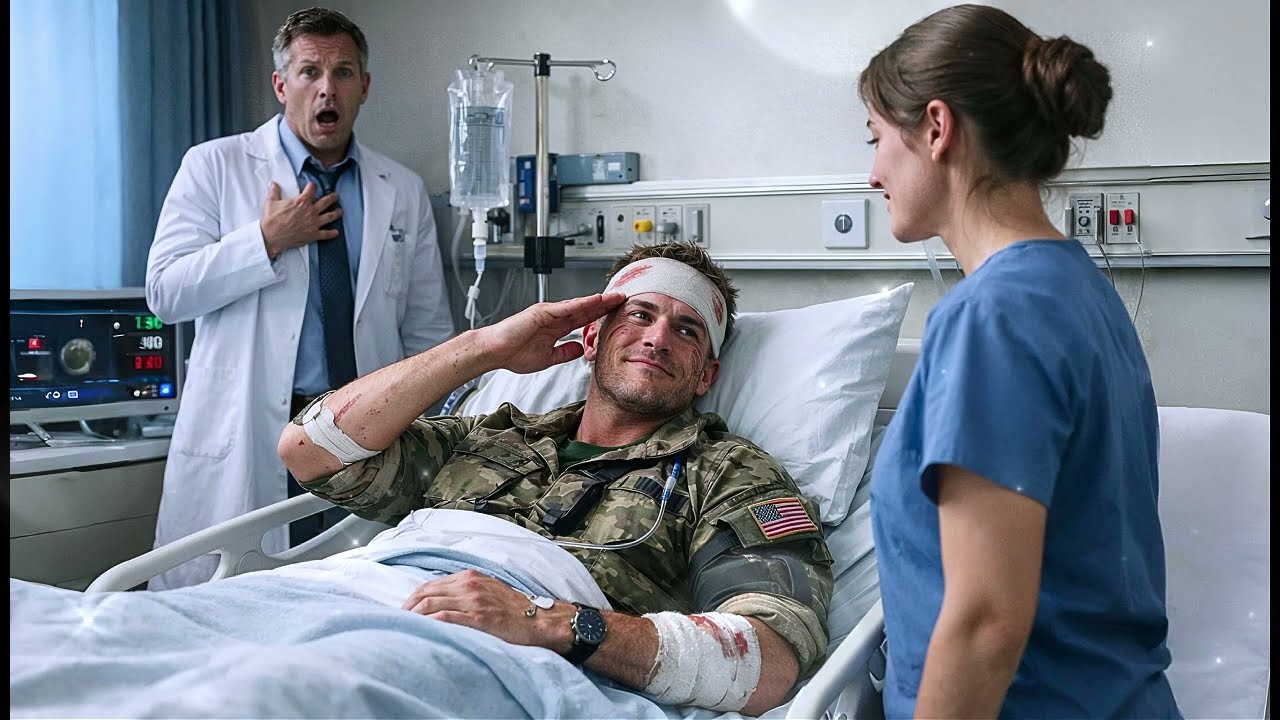
He didn’t say another word to her. He didn’t need to. He simply stepped back, brought his boots together with a sharp snap, and raised his hand in a slow, crisp, perfectly executed salute.
In the middle of the chaotic, blood-stained emergency room, surrounded by stunned doctors and nurses who had mocked her for weeks, the military elite was saluting the newbie.
The silence in the trauma bay was absolute, broken only by the steady, rhythmic beeping of Commander Reynolds’ stabilized heart monitor. Captain James Donovan held his salute for a long, heavy moment before sharply dropping his hand. The sheer weight of that gesture hung in the air, a devastating rebuke to every civilian in the room who had spent the last three weeks treating Clara like an incompetent nuisance.
Dr. Richard Pembroke was the first to break the silence, his voice a frantic, high-pitched stammer that completely betrayed his usual suave demeanor. “Captain Donovan, with all due respect, you do not understand the situation,” Pembroke protested, peeling himself off the wall and aggressively pointing a finger at Clara.
“This woman is a registered nurse, not a licensed physician. She just performed an unauthorized, highly invasive needle thoracostomy. That is a gross violation of hospital protocol and state medical law.
She is a massive liability.”
Donovan slowly turned his head. His eyes, cold and flat as slate, locked onto Pembroke. The tactical operator who had previously pinned the doctor took a subtle half-step forward, his hand resting casually on the sling of his rifle.
“What I understand, Doctor,” Donovan said, his voice a quiet, terrifying rumble, “is that you took one look at a decorated Navy SEAL, smelled a broken bottle of whiskey, and decided his life wasn’t worth your time. You left him in a closet to suffocate. If this combat medic hadn’t ignored your profound incompetence, my commander would be in a body bag right now.”
Pembroke’s jaw worked silently, his face flushing a deep, mottled crimson. “I am the chief attending trauma surgeon in this facility. You cannot speak to me—” “I just did,” Donovan cut him off abruptly.
 He turned away, completely dismissing the surgeon, and looked back at Clara. “Thompson, what’s his status?” Clara didn’t miss a beat.
The chaotic civilian ER had vanished. She was back in her element, reporting to a superior officer.
“He requires immediate surgical intervention, sir. The needle decompression bought us time, but he has severe internal hemorrhaging, likely a ruptured spleen, possible hepatic lacerations, and we need a chest tube placed properly to manage the pneumothorax. We need an operating room right now.”
Donovan nodded. He keyed a microphone attached to his tactical vest. “Viper Actual to base.
We have Commander Reynolds. He is critically wounded but stable for transport to surgery. We are locking down the surgical wing of Coronado General.”
He released the mic and looked at the stunned charge nurse, Brenda. “Who is your best trauma surgeon? And do not give me the man who just tried to murder my CO.”
Brenda swallowed hard, glancing nervously at a furious Pembroke before looking at the captain. “Dr. Sarah Lynn.
She’s the senior cardiothoracic and trauma attending. She’s up on the third floor right now.” “Page her.
Tell her to prep OR One,” Donovan ordered. He gestured to two of his heavily armed men. “Secure the elevators.
Nobody gets on or off that floor without my authorization.”
“You can’t do this,” Pembroke shrieked, finally losing the last thread of his professional sanity. “This is a civilian hospital. I am calling the police.”
“Call them,” Donovan replied without looking back. “Tell them the Department of Defense has temporarily commandeered your trauma ward under the National Security Act. Thompson, you’re with us.
Move him.” Clara didn’t hesitate. She grabbed the head of the gurney, unlocking the brakes.
Two SEALs stepped in to help her, their massive frames easily guiding the heavy bed out of the bay.
They bypassed Pembroke completely, leaving him standing in the middle of the ER, his authority shattered in front of the entire nursing staff. The journey to the third floor was a blur of motion and stark efficiency. The moment they rolled into the pre-op staging area, Dr.
Sarah Lynn was waiting. Unlike Pembroke, Dr. Lynn was famously pragmatic, a brilliant surgeon who cared solely about patient outcomes.
She took one look at the tactical team, the bleeding SEAL, and Clara holding pressure on a secondary laceration, and simply nodded.
“Let’s get him on the table,” Dr. Lynn said, snapping on her gloves. “Captain, your men need to stay behind the red line.
Nurse, I need you scrubbing in. We are severely understaffed tonight, and my surgical resident is tied up in an appendectomy. Can you handle a rapid infuser and anticipate my instruments?”
“Yes, doctor,” Clara said, already moving towards the scrub sinks.
The next three hours were a grueling, blood-soaked marathon. Commander Reynolds’ injuries were catastrophic. The impact of the eighteen-wheeler had shattered four ribs, pulverized his spleen, and nicked his intercostal artery.
The moment Dr. Lynn opened his abdominal cavity, it was a race against the clock. Clara moved with a mechanical, flawless precision that left the circulating nurses in awe.
She didn’t wait for Dr. Lynn to ask for clamps. She had them slapped into the surgeon’s palm the second they were needed.
When Reynolds’ blood pressure suddenly bottomed out due to a hidden arterial bleed, Clara simultaneously managed the massive transfusion protocol, pushing units of O-negative blood while physically assisting Dr. Lynn in packing the abdomen with lap sponges to staunch the flow. She had done this a hundred times in tents vibrating from mortars under the beam of cheap headlamps.
Here, under the pristine shadowless surgical lights of Coronado General, it felt almost easy.
Dr. Lynn worked frantically, her brow beaded with sweat. “Clamp, suture.
Thompson, give me more suction down here. I can’t see the bleeder.” Clara expertly maneuvered the suction tip, clearing the pooling blood just in time for Lynn to spot the torn artery and clamp it shut.
The monitor’s frantic beeping slowly settled into a steady, reassuring rhythm. The crisis had passed.
Dr. Lynn exhaled a long, shaky breath, her shoulders dropping. She looked across the operating table at Clara, who was quietly wiping a stray drop of blood from the patient’s chest.
“I’ve worked with twenty-year veteran surgical nurses who don’t move as fast as you just did,” Dr. Lynn said quietly, her eyes filled with genuine respect. “Pembroke told the entire staff you were a timid, slow-witted rookie who couldn’t handle a simple IV.”
Clara met the surgeon’s gaze over her mask. “Dr. Pembroke only sees what he wants to see, Doctor.”
“Well,” Lynn said, a small, grim smile forming beneath her mask. “He’s going to have a very hard time unseeing tonight.”
Morning broke over San Diego, casting a pale, gray light through the rain-streaked windows of Coronado General. In the intensive care unit, Commander David Reynolds was finally resting peacefully, a network of tubes and monitors keeping a silent, digital watch over his recovery. Outside his door, two armed Navy SEALs stood like statues, turning away anyone who didn’t have clearance from Captain Donovan.
Four floors below, in the mahogany-paneled boardroom of the hospital’s executive suite, a very different kind of battle was brewing. Clara sat perfectly straight in a plush leather chair, her hands folded neatly in her lap. She had finally changed out of her blood-stained scrubs and into her civilian clothes.
Across the long conference table sat Richard Bauer, the hospital’s CEO, and Dr. Evelyn Carmichael, the chief of medicine. And sitting next to them, looking incredibly smug and clutching a thick manila folder, was Dr.
Richard Pembroke.
“Ms. Thompson,” Bauer began, clearing his throat uncomfortably. He was a bureaucrat, a man who viewed the hospital strictly through the lens of liability and profit margins.
“We have convened this emergency disciplinary hearing regarding the events of last night. Dr. Pembroke has filed a severe, formal grievance against you.”
“She assaulted a patient,” Pembroke interrupted, leaning forward, his voice dripping with venomous satisfaction. “She bypassed my explicit medical orders, fabricated a diagnosis, and performed an invasive surgical procedure, a needle thoracostomy, without a medical license. This is a profound breach of protocol.
It is grounds for immediate termination, and frankly, I am pushing for the hospital to file criminal charges for practicing medicine without a license.”
Dr. Carmichael, an older woman with sharp eyes, looked at Clara. “Nurse Thompson, your personnel file notes military medical experience, but that does not supersede California state medical law.
You bypassed an attending physician. Why?” “Because the attending physician was allowing a patient to die of a tension pneumothorax,” Clara said, her voice completely devoid of emotion.
She didn’t sound defensive. She sounded factual. “Dr.
Pembroke misdiagnosed profound hypovolemic shock and a collapsed lung as alcohol intoxication. The patient had less than three minutes before his heart stopped. I acted under the implied consent of a dying patient and the emergency doctrine to preserve life.”
“He was a vagrant who reeked of cheap whiskey,” Pembroke snapped, slamming his hand on the table. “You got lucky, Thompson. That’s all.
You were a guest and you got lucky. But luck does not excuse you going rogue and putting this hospital at risk of a massive malpractice lawsuit.” Bauer sighed heavily, looking at a piece of paper in front of him.
“Regardless of the patient’s identity or the ultimate outcome, we cannot have nurses undermining our chief surgeons. The liability is simply too great. Ms.
Thompson, it is the decision of this board to terminate your employment at Coronado General, effective immediately. Furthermore, we are legally obligated to forward Dr. Pembroke’s complaint to the State Board of Nursing for review.”
Pembroke leaned back in his chair, a victorious, sneering smile spreading across his face. He had won. He had crushed the girl who had dared to humiliate him.
Clara didn’t blink. She didn’t cry. She simply nodded, slowly, preparing to stand up and walk away.
She had faced worse monsters than Richard Pembroke. Before she could move, the heavy oak doors of the boardroom swung open with a violent crack.
Captain James Donovan strode into the room, looking even more imposing in the stark daylight. He wasn’t in his tactical gear anymore. He wore a perfectly pressed navy service dress blue uniform, ribbons covering his chest.
Trailing right behind him was a man in a sharp, expensive suit carrying a briefcase, and two uniformed San Diego police detectives. “I apologize for the interruption, gentlemen,” Donovan said, his voice echoing off the paneled walls. He didn’t look sorry at all.
“But this meeting is over.”
Bauer stood up, his face flushing with indignation. “Captain Donovan, I appreciate what your men do, but you cannot barge into a closed executive disciplinary hearing.” “Sit down, Mr.
Bauer,” the man in the suit commanded. He walked straight to the head of the table and placed his briefcase down. “I am Lieutenant Commander Thomas Wright, Judge Advocate General’s Corps, United States Navy.
And as of 0600 hours this morning, the Department of Defense has placed an injunction on any disciplinary action against Nurse Clara Thompson.”
Pembroke stood up, his face pale. “You can’t do that. She broke the law.”
“The only person who broke the law last night, Dr. Pembroke, is you,” Wright said smoothly, opening his briefcase and pulling out a stack of glossy photographs. He tossed them onto the center of the table.
They were traffic camera stills, enhanced and blown up. They showed a heavy, unmarked eighteen-wheeler deliberately swerving across three lanes of traffic to smash into Commander Reynolds’ motorcycle, driving him violently into the ditch. The final photo showed a man stepping out of the truck, pouring a bottle of liquid over the unconscious SEAL, and fleeing the scene.
The boardroom went dead silent. “Commander Reynolds was returning from a classified joint task force operation that successfully dismantled a major cartel smuggling ring operating out of the Port of San Diego,” Captain Donovan explained, his eyes fixed dead on Pembroke. “That crash was not an accident.
It was a highly coordinated, targeted assassination attempt.” Donovan leaned over the table, bringing his face uncomfortably close to Pembroke’s. “They knew Reynolds was tough to 𝓀𝒾𝓁𝓁,” Donovan continued, his voice dropping to a lethal whisper.
 “So, they didn’t just hit him. They poured cheap whiskey all over his clothes. They knew that if a massive, bearded, bleeding man smelling like booze rolled into a busy civilian ER on a rainy night, an arrogant, overworked doctor would take one look at him, label him a drunk, and shove him in a corner to die without a proper examination.”
The color drained entirely from Dr. Carmichael’s face as the horrifying reality set in. Pembroke staggered back slightly, his mouth opening and closing like a suffocating fish.
“They engineered a psychological trap, Doctor,” Wright said, his voice cold and clinical, “and you walked right into it. Your gross medical negligence almost completed an assassination on a high-ranking military officer. If it wasn’t for Nurse Thompson’s combat-trained situational awareness, Commander Reynolds would be dead, and you would be facing a federal investigation for involuntary manslaughter.”
Bauer, the CEO, looked like he was about to pass out. “Captain, we had no idea. The hospital will, of course, cooperate fully with any investigation.”
“You will,” Wright agreed, handing Bauer a thick legal document. “Furthermore, under the federal Good Samaritan laws and the protection of the armed forces, Nurse Thompson’s actions are fully shielded from civilian liability. The Secretary of the Navy is personally drafting a letter of commendation for her.
If this hospital terminates her, or if Dr. Pembroke files his complaint with the nursing board, the DoD will immediately pull all Tricare funding and military personnel contracts from Coronado General. We will bankrupt this facility by Friday.”
Wright turned to look at Dr. Pembroke, who was now trembling visibly. “As for you, doctor, the San Diego police detectives are here to escort you to the station.
You are being brought in for questioning regarding your actions last night. The medical board has already been notified of your suspension pending a full review of your clinical judgment.” Pembroke looked around wildly, seeking an ally.
He looked at Bauer, who immediately looked away. He looked at Carmichael, who was staring at him with undisguised disgust. Finally, his eyes landed on Clara.
Clara remained seated, her face a mask of calm composure. She looked at the man who had tormented her, who had tried to destroy her career out of sheer petty ego. She didn’t smile.
She didn’t gloat. She simply watched him fall. “Officers,” Captain Donovan said, nodding to the detectives, “take him out of here.”
Pembroke didn’t fight as the detectives flanked him. He looked like a deflated balloon, his arrogance entirely stripped away, leaving only a terrified, broken man. He was escorted out of the boardroom in silence, the heavy oak doors clicking shut behind him.
The room was quiet for a long moment. Bauer and Carmichael sat frozen, the entire hierarchy of their hospital violently rearranged in a matter of minutes. Captain Donovan turned to Clara.
The cold, lethal edge vanished from his eyes, replaced by a deep, unwavering warmth. “Nurse Thompson,” Donovan said softly, “Commander Reynolds woke up about twenty minutes ago. He’s in a lot of pain, but his mind is sharp.
He asked to meet the soldier who kept him in the fight.”
Clara finally stood up. She smoothed the front of her shirt, the ghost of a smile finally touching the corners of her lips. She looked at the hospital administrators who were now staring at her with a mixture of terror and profound respect.
“Excuse me, Mr. Bauer, Dr. Carmichael,” Clara said politely.
“I believe I have a patient to check on.” She walked out of the boardroom alongside Captain Donovan, leaving the executives sitting in the ruins of their own arrogance.
As they walked down the hallway towards the ICU, the sterile lights of the hospital seemed a little less harsh, the air a little easier to breathe. The intensive care unit at Coronado General was a stark contrast to the chaotic battlefield of the emergency room. Here, the lights were dimmed and the frantic shouting was replaced by the low, steady hum of ventilators and the rhythmic pulse of cardiac monitors.
Captain James Donovan swiped his clearance badge, pushing open the heavy glass doors to room 412. Commander David Reynolds looked distinctly out of place in the sterile, white hospital bed. Even battered, bruised, and heavily bandaged, his sheer physical presence commanded the room.
Thick plastic tubing snaked from his chest to a drainage canister on the floor, managing the pneumothorax Clara had temporarily relieved. His left arm was in a heavy cast and a web of dark, purple stitches tracked across his forehead.
As Clara walked in, Reynolds slowly turned his head. His eyes, a piercing, icy blue, were startlingly lucid despite the heavy doses of intravenous morphine pumping through his veins. He looked at Clara, his gaze sweeping over her small, unassuming frame.
“So,” Reynolds said, his voice a gravelly, painful rasp that still carried absolute authority. “You’re the ghost who pulled me back from the ledge.”
Clara stood at the foot of his bed, her posture instinctively shifting into parade rest. “Just doing my job, Commander. You had a tension pneumo that needed immediate decompression.
The needle thoracostomy was a temporary bridge until Dr. Lynn could get you into the OR.” Reynolds let out a short, dry chuckle, wincing as the movement pulled at his shattered ribs.
“Captain Donovan gave me the after-action report. He told me the attending physician tried to tag and bag me as a drunk transient. He also told me you practically dared him to fire you while you shoved a fourteen-gauge needle into my chest.”
“Dr. Pembroke lacked field awareness, sir,” Clara replied diplomatically, though her green eyes remained hard. “He saw what he expected to see, not what was actually bleeding on his table.”
Reynolds nodded slowly. He laboriously lifted his right hand, gesturing for Clara to come closer to the side of the bed. When she stepped forward, he looked at her name badge, then back up to her face.
“Donovan said your file listed you as a 68W Airborne, deployed to the Arghandab River Valley in 2018,” Reynolds said, his voice dropping to a quieter, more intimate register. Clara felt a sudden chill run down her spine. The Arghandab Valley was a meat grinder.
It was the deployment she rarely spoke about, the one that haunted her quietest nights. “Yes, sir. Forward Operating Base Frontenac.”
“August fourteenth,” Reynolds continued, his eyes locked onto hers. “A joint patrol hit a triple-stacked IED outside a village near the river. Three Humvees completely shredded.
A medevac bird was called in under heavy enemy fire. The flight medic on that Black Hawk jumped out of a hovering chopper into a hot landing zone because the hoist jammed. She dragged two critically wounded Navy EOD techs out of the 𝓀𝒾𝓁𝓁 zone while taking grazing fire to her own shoulder.”
Clara’s breath caught in her throat. She instinctively reached up, her fingers grazing her left shoulder where a faded, puckered scar sat hidden beneath her shirt. “One of those EOD techs,” Reynolds rasped, his eyes glistening with unshed emotion, “was Chief Petty Officer Thomas Reardon.
Tommy was my best friend. He was the godfather to my youngest daughter. If he had bled out in that dirt, a piece of my soul would have died with him.”
Reynolds reached out, his massive, calloused hand weakly grasping Clara’s wrist. “Tommy told me about the medic who saved him,” Reynolds whispered. “He said she was a quiet girl with green eyes who moved like she was completely bulletproof.
He never got to thank her properly before she rotated out. He died three years later in a training accident off the coast of Virginia. But because of you, he got three extra years to watch his little girl learn how to walk.”
The sterile walls of the hospital seemed to fall away. For the first time since she had walked into Coronado General, the impenetrable armor Clara wore finally cracked. A single tear slipped down her cheek.
“He was a good man, Commander,” Clara said softly, her voice thick with emotion. “He kept telling me jokes the entire flight back to Bastion to keep his squadmate calm. I never forgot him.”
“And I will never forget you, Thompson,” Reynolds said, his grip tightening slightly on her wrist. “You didn’t just save my life last night. You saved the man who held my brother’s hand in the dark.
You have a blank check with the teams for the rest of your life.”
Six months later, the landscape of Coronado General’s emergency room had fundamentally transformed. Dr. Richard Pembroke was gone.
Following the explosive revelations in the boardroom, the subsequent police investigation uncovered a disturbing pattern of gross medical negligence and falsified patient charts designed to keep Pembroke’s mortality statistics artificially low. His medical license was permanently revoked by the state board, and he was currently awaiting trial on federal charges of criminal negligence and reckless endangerment.
In his absence, Dr. Sarah Lynn had been promoted to chief of trauma surgery. Her first official act was to tear up Clara’s probationary rookie contract and promote her to lead trauma charge nurse.
Under Clara’s leadership, the ghost became the undeniable heartbeat of the ER. She instituted rigorous triage protocols based on battlefield triaging, entirely eliminating the dangerous blind spots that had allowed patients to slip through the cracks. The younger nurses no longer snickered at her.
They shadowed her every move, desperate to learn the flawless rapid-fire efficiency she brought to every code blue.
But the ultimate test of Clara’s character, and the final dramatic twist in her journey at Coronado General, arrived on a sweltering night in mid-July. The ER double doors blew open with terrifying force. A swarm of DEA agents and heavily armed SWAT officers flooded the triage bay, shouting orders and securing the perimeter.
Behind them, paramedics frantically wheeled in three stretchers completely soaked in blood.
“Multiple gunshot wounds!” a paramedic screamed. “High-velocity rifle rounds to the chest and abdomen.
We have three tangos down, critical condition.” The hospital staff froze. The DEA raid had been all over the local scanners.
These weren’t innocent bystanders. These were the top enforcers of the cartel smuggling ring that had orchestrated the assassination attempt on Commander David Reynolds six months prior. These were the men who had poured whiskey on a dying American hero and left him in a ditch.
A young resident doctor backed away from the first stretcher, his face pale with disgust. “I’m not touching them,” he muttered. “Let them bleed.”
The atmosphere in the trauma bay turned dangerously toxic. The urge for retribution, the desire to let these violent men suffer the exact fate they had inflicted on others, hung heavy in the air.
“Everyone, stop!” Clara’s voice cut through the chaos like a whip crack. She stepped into the center of the trauma bay, her eyes flashing with absolute authority.
She looked at the young resident, then at the hesitating nurses. “They are dying men,” Clara stated, her voice echoing off the tile walls. “They are not cartel enforcers in this room.
They are not assassins. They are massive internal hemorrhages, tension pneumothoraces, and shattered femurs. The courts will judge their souls.
The prison system will exact their punishment. But in this room, we are medical professionals.”
She grabbed a pair of trauma shears and stepped up to the nearest stretcher, looking down at the tattooed, bleeding cartel hit man who was gasping for air. “If we let them die because of who they are,” Clara said, turning to look directly at the young resident, “then we are no better than Dr. Pembroke.
We do not get to choose who deserves to live. We just hold the line.”
The silence in the room was deafening, but the truth in her words was undeniable. Slowly, Dr. Lynn stepped up beside Clara, snapping on a pair of sterile gloves.
“You heard the charge nurse,” Lynn ordered the room. “Let’s get to work.” As Clara expertly inserted an IV line into the arm of the man who had tried to 𝓀𝒾𝓁𝓁 Commander Reynolds, she felt a profound sense of peace.
She had survived the battlefields of the Middle East, and she had survived the toxic arrogance of civilian medicine. She had proven that true strength wasn’t about ego, rank, or judging the worthiness of the wounded. It was about having the courage to kneel in the blood and the dirt, time and time again, and fight for the fragile spark of human life.
Clara Thompson’s journey from a dismissed newbie nurse to the undisputed leader of Coronado General’s trauma ward serves as a stark reminder that true competence rarely shouts. It simply performs when the absolute worst occurs. The dramatic fall of Dr.
Richard Pembroke highlights the dangerous, sometimes fatal consequences of arrogance and unchecked bias in high-stakes environments. Meanwhile, Clara’s unwavering dedication, culminating in her decision to save the very man who tried to 𝓀𝒾𝓁𝓁 Commander Reynolds, proves that a medical oath is an ironclad commitment to humanity, not a conditional favor. Ultimately, this story is a testament to the quiet heroes who walk among us, carrying the heavy, unseen burdens of their pasts while continuously holding the line between life and death.