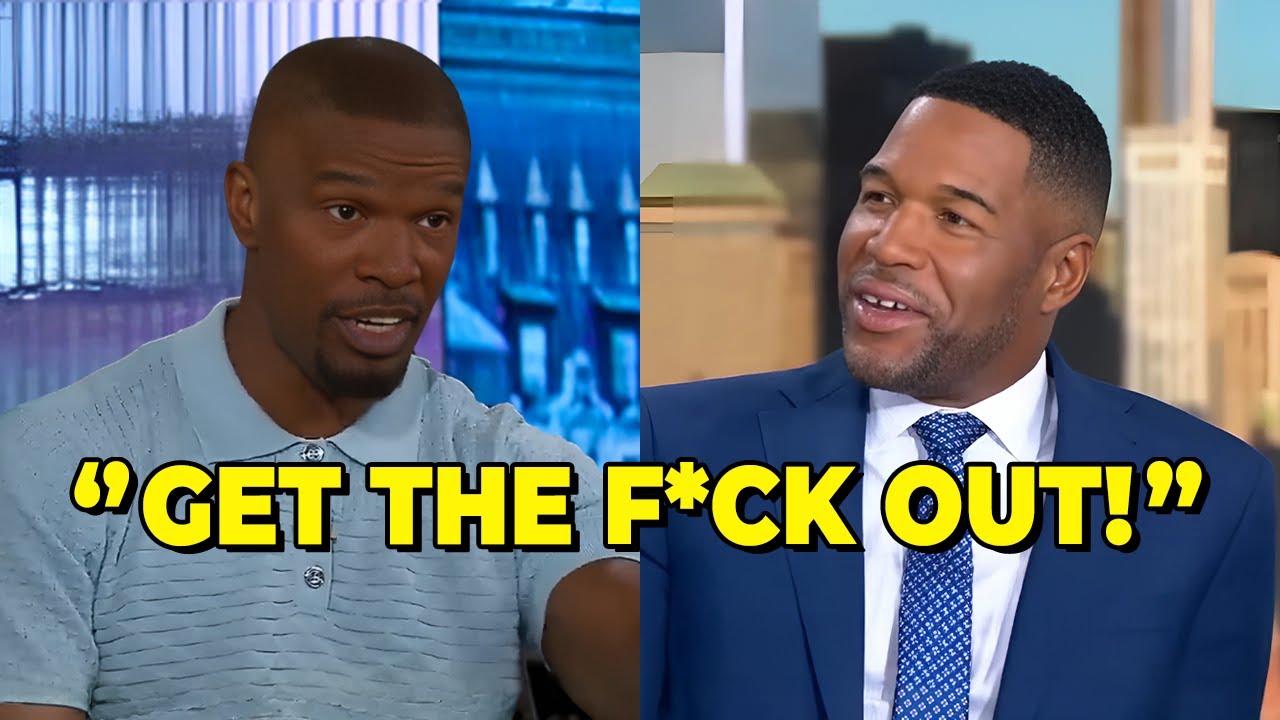
In a 𝓈𝒽𝓸𝒸𝓀𝒾𝓃𝑔 live television debacle on Good Morning America, Jamie Foxx was abruptly escorted off the set after a fiery confrontation with host Michael Strahan. The actor, there to promote his latest film, faced a barrage of disrespectful questions and personal attacks, leading to accusations of bullying that left co-hosts stunned and viewers reeling.
The incident unfolded in real time, turning a routine celebrity interview into a public spectacle. Foxx, known for his charisma and Oscar-winning talent, entered the studio with his trademark smile, ready to discuss his new project. But Strahan’s tone quickly shifted from welcoming to combative, questioning Foxx’s career choices with a condescension that escalated tensions.
Strahan, flanked by co-hosts Robin Roberts, George Stephanopoulos, and Ginger Zee, began by probing Foxx’s roles in a way that felt more like an ambush than an interview. “You’ve been in Hollywood for decades,“ Strahan said, implying stagnation in Foxx’s work. The actor tried to respond gracefully, highlighting his diverse roles, including his acclaimed portrayal of Ray Charles.
But Strahan pressed on, dismissing Foxx’s achievements as outdated and accusing him of lacking depth. The studio fell silent as Roberts and others attempted to intervene, their discomfort palpable. Foxx, maintaining composure at first, finally pushed back, calling out the hostility as unprofessional and unwarranted.
“You’re not asking questions; you’re being rude,“ Foxx declared, his voice steady yet firm. The exchange intensified, with Strahan rising from his seat, accusing Foxx of being “too sensitive“ and referencing unverified claims about his behavior on sets. Co-hosts exchanged uneasy glances, their attempts to de-escalate ignored.
The confrontation reached a boiling point when Foxx stood up, removing his microphone in a defiant gesture. “I’m done here,“ he said, addressing the room. “This isn’t an interview; it’s disrespect.“ Producers likely scrambled behind the scenes as the live feed captured every tense moment, amplifying the 𝒹𝓇𝒶𝓂𝒶 for millions.
Viewers at home were glued to their screens, witnessing a rare breakdown of morning TV decorum. Social media erupted almost instantly, with clips of the clash going 𝓿𝒾𝓇𝒶𝓁. Hashtags like #StrahanScandal and #SupportJamieFoxx trended, as fans and critics debated the ethics of celebrity interviews.
Roberts, ever the voice of reason, tried to apologize on air, her eyes reflecting shock. “This is not how we operate,“ she said, turning to Strahan. But he doubled down, insisting he was just being “honest,“ a stance that only fueled the outrage.
Foxx’s exit was swift and dignified, leaving the set amid a hush of awkward silence. As he departed, he hugged Roberts and shook hands with Stephanopoulos and Zee, praising their professionalism. “You three are the heart of this show,“ he told them, a subtle rebuke to Strahan.
The fallout was immediate. Industry insiders speculated on the damage to Good Morning America’s reputation, a staple of American breakfast routines. Foxx, in subsequent statements, emphasized his commitment to respectful discourse, turning the incident into a broader conversation about media accountability.
Strahan’s behavior drew sharp criticism from colleagues and viewers alike. Many pointed to his sports background as a former NFL star, suggesting it fostered a confrontational style ill-suited for talk show hosting. The network faced a PR crisis, with calls for an internal review.
In the hours after the broadcast, Foxx’s team released a statement praising his restraint. “Jamie handled the situation with grace, refusing to engage in toxicity,“ it read. The actor continued his press tour elsewhere, drawing even larger audiences eager to hear his side.
This event highlights the fine line between tough journalism and outright aggression. In an era of 𝓿𝒾𝓇𝒶𝓁 moments, Strahan’s approach may have backfired, alienating fans and tarnishing the show’s image. Good Morning America, known for its uplifting segments, now grapples with the consequences.
Experts in media ethics weighed in, arguing that hosts must balance scrutiny with courtesy. “Celebrities are human beings first,“ one analyst noted. Foxx’s stand became a symbol of resistance against undue hostility, resonating with anyone who’s faced unwarranted criticism.
As the day progressed, more details emerged from eyewitnesses. Crew members described a chaotic atmosphere, with producers urging a commercial break too late. The incident’s ripple effects extended to advertisers, some expressing concern over the network’s handling.
Foxx’s film, central to the original interview, gained unexpected buzz. Promotional clips circulated widely, with audiences applauding his talent anew. The irony wasn’t lost on observers: a moment meant to promote his work instead spotlighted his resilience.
Strahan remained defiant in follow-up segments, downplaying the clash as “passionate discussion.“ But his co-hosts disagreed publicly, with Roberts calling it “a regrettable lapse.“ The episode served as a wake-up call for the industry, prompting talks on better guest protections.
In retrospect, this confrontation underscores the power dynamics in live TV. Foxx, a veteran of the spotlight, demonstrated poise under pressure, turning potential embarrassment into empowerment. His departure wasn’t defeat; it was a statement.
The broader implications linger, sparking debates on social platforms about celebrity treatment. Has morning TV become too formulaic, or is this an isolated incident? Either way, it forces a reckoning on respect in media.
As evening fell, Foxx was seen at another event, engaging fans with his usual warmth. The day had been tumultuous, but he emerged unscathed, his star shining brighter. For Good Morning America, the road to recovery begins now.
This breaking story continues to unfold, with potential repercussions for all involved. Stay tuned for updates as more details emerge from this unprecedented TV clash. The world watches, waiting to see how the pieces fall.